kodymedical@gmail.com
 +91-9380223396
 My Account
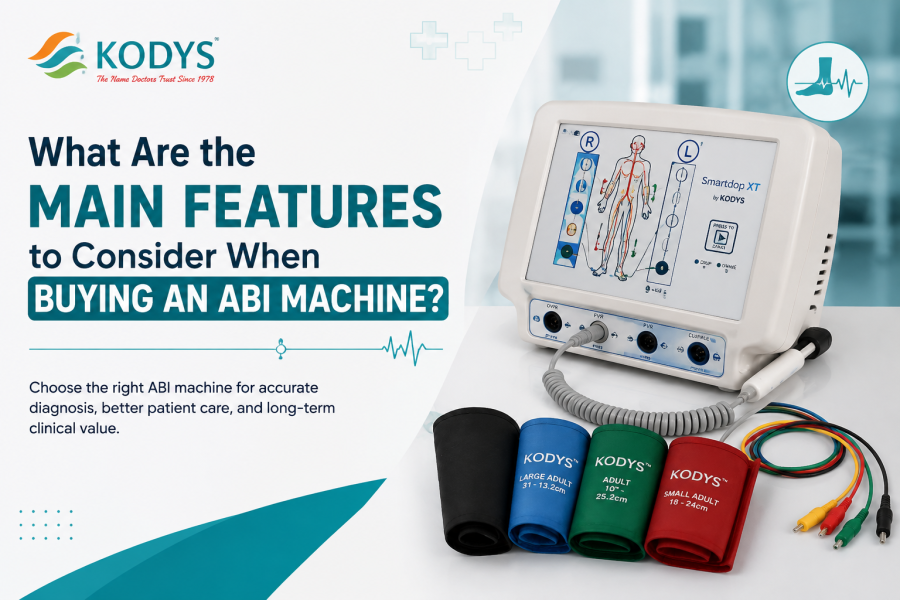
An automatic ABI (ankle-brachial index) machine should be evaluated on seven core factors: level of automation, combined measurement methods, TBI capability for diabetic patients, software and reporting integration, portability versus console design, probe and accessory compatibility, and after-sales support. Getting this checklist right before purchase prevents costly mismatches between equipment capability and actual clinic workflow.
For hospitals, diabetic foot clinics, and diagnostic centers investing in vascular screening infrastructure, an ABI machine is rarely a one-time, isolated purchase decision—it usually anchors an entire vascular diagnostic workflow. Kody Medical’s own Hadeco Smartdop XT and Smartdop 30EX platforms are useful reference points throughout this checklist, since between them they illustrate almost every trade-off buyers need to weigh.
1. Single-Site vs. Multi-Site Automation
The first decision point is how many limb sites the machine can test simultaneously. Entry-level systems handle a single site at a time with manual cuff repositioning, while advanced platforms automate blood pressure capture across multiple ports in one session. The Smartdop XT is available in configurations offering fully automatic cuff inflation and deflation across up to 6 sites, with semi-automatic measurement extending to as many as 14 sites—giving busy hospitals a way to screen more patients per day without sacrificing accuracy. Smaller clinics with lighter patient loads may not need this level of throughput, which is where a compact single-unit device becomes more cost-effective.
2. Combined Measurement Methods
Not all ABI machines rely on the same underlying technology. Some use oscillometry alone; others integrate Doppler-based detection or add photoplethysmography (PPG) for toe pressure and pulse volume work. The Smartdop XT combines all three—oscillometry, Doppler, and PPG—in a single platform, so clinicians aren’t limited to ABI alone and can run TBI and PVR studies in the same session. This kind of multi-modality integration is worth checking closely, since single-method machines often require a second device down the line. Our Pulse Volume Recording (PVR) guide covers what that waveform data actually tells clinicians.
3. TBI Capability — Non-Negotiable for Diabetic Populations
If your clinic serves a significant diabetic or elderly population, toe-brachial index (TBI) capability isn’t optional. Ankle arteries in these patients often become calcified and non-compressible, which artificially inflates ABI readings and can mask genuine peripheral arterial disease. TBI measurement—using PPG probes at the toes rather than ankle cuffs—sidesteps this problem. This is precisely why Kody Medical built TBI directly into the Smartdop XT rather than treating it as an afterthought: for diabetic foot clinics, it’s frequently the more clinically reliable number.
4. Software and Reporting Integration
Modern ABI systems shouldn’t just capture raw pressure data—they should automate calculation, storage, and reporting. The Smartdop XT connects via USB to Smart XT Link, Windows-based software included with the system, which controls testing, auto-calculates ABI and TBI values, stores patient records, and generates standardized printable reports. This removes manual calculation errors and produces documentation that supports both clinical review and insurance reimbursement—ask any vendor directly whether reporting software is bundled or sold separately, since that materially changes total cost.
5. Portable vs. Console-Based Systems
There’s a genuine trade-off between compact, standalone Doppler-based ABI units and larger, PC-linked multi-port consoles. This is exactly the difference between Kody’s own two platforms: the Smartdop XT is a fully automatic, software-driven console suited to high-volume vascular labs and hospitals, while the Smartdop 30EX is a compact, self-contained bidirectional Doppler unit with an automatic cuff inflator and integrated printer—built for clinics that want ABI and TBI testing without a dedicated workstation. Reviewing both side by side is often the fastest way to understand which category your clinic actually needs; see our Handheld and Vascular Doppler Buyers’ Guide for more on portable-format devices generally.
6. Probe and Accessory Compatibility
Check what accessory probes the system supports beyond the base unit. The Smartdop XT accepts optional bidirectional Doppler probes at multiple frequencies, PPG probes for toe pressure and venous reflex studies, and temperature probes for foot temperature assessment in diabetic patients. Confirming this compatibility upfront avoids a scenario where your clinic later needs a capability the base machine can’t support without a full replacement.
7. After-Sales Support and Service Turnaround
An ABI machine is a long-term clinical asset. Ask suppliers directly about warranty terms, AMC coverage, calibration schedules, and service response time. Kody Medical positions its Smartdop XT and 30EX ranges specifically for hospitals, diabetic clinics, and diagnostic centers across India that need dependable, serviceable equipment—not just a strong spec sheet on paper. Our Vascular Doppler Maintenance Guide outlines the kind of ongoing upkeep this equipment category typically requires.
Frequently Asked Questions
What is the most important feature in an ABI machine for a diabetic clinic?
TBI capability is the single most important feature for diabetic-focused clinics, since standard ABI readings can be unreliable in patients with calcified, non-compressible arteries—a gap the Smartdop XT specifically addresses.
What’s the difference between Smartdop XT and Smartdop 30EX?
Smartdop XT is a fully automatic, multi-site, software-driven vascular testing system, while Smartdop 30EX is a compact, self-contained bidirectional Doppler unit with automatic cuff inflation—the choice comes down to patient volume and whether you need a dedicated workstation.
Do all ABI machines include PVR testing?
No pulse volume recording typically requires PPG or cuff-based waveform capture alongside standard ABI. The Smartdop XT includes this as part of its combined ABI/TBI/PVR platform.
What does “automatic” actually mean in an ABI machine—does it eliminate the need for a technician?
No automation refers to cuff inflation, deflation, and pressure calculation being handled by the device rather than manually. In Kody Medical’s Smartdop XT, this means Smart XT Link software controls the testing sequence and calculates ABI/TBI values automatically, which reduces operator dependency and speeds up testing but a trained technician is still needed to position cuffs and probes correctly and interpret results. Automation improves consistency and throughput, not staffing requirements.
Can one Kody Medical ABI machine handle both hospital and diabetic outpatient clinic use, or do these need different devices?
Yes—this is exactly why Kody Medical offers two distinct platforms rather than one. The Smartdop XT’s multi-port configuration (up to 6 fully automatic or 14 semi-automatic sites) suits high-throughput hospital vascular labs, while the compact Smartdop 30EX is built for smaller diabetic outpatient clinics that don’t need a dedicated workstation. The deciding factor is daily patient volume and available space, not the setting itself.
How long does a typical ABI, TBI, and PVR test take on Kody Medical’s Smartdop XT per patient?
A fully automated multi-site system like the Smartdop XT can usually complete ABI, TBI, and PVR measurements for one patient in roughly 10–15 minutes, compared to 20–30 minutes or longer with manual Doppler-based testing. Exact timing depends on how many limb sites are tested and whether PVR waveforms are captured in the same session.
Is Kody Medical’s Doppler-based ABI testing more accurate than oscillometric-only devices?
Doppler-based detection is generally considered more reliable for weak or irregular pulses, since it directly detects blood flow signals rather than inferring pressure from cuff oscillations. This is why Kody Medical’s Smartdop XT combines oscillometry, Doppler, and PPG in one platform rather than relying on a single method—the combination lets clinicians cross-verify results, which is particularly useful in diabetic patients with compromised circulation.
Does Kody Medical’s Smartdop XT require internet connectivity or cloud storage to generate reports?
No—the Smartdop XT generates and stores reports locally through its USB-connected Smart XT Link software rather than requiring cloud access. This is generally preferred in Indian hospital and clinic settings for patient data security and to avoid dependency on internet connectivity during testing.