kodymedical@gmail.com
 +91-9380223396
 My Account
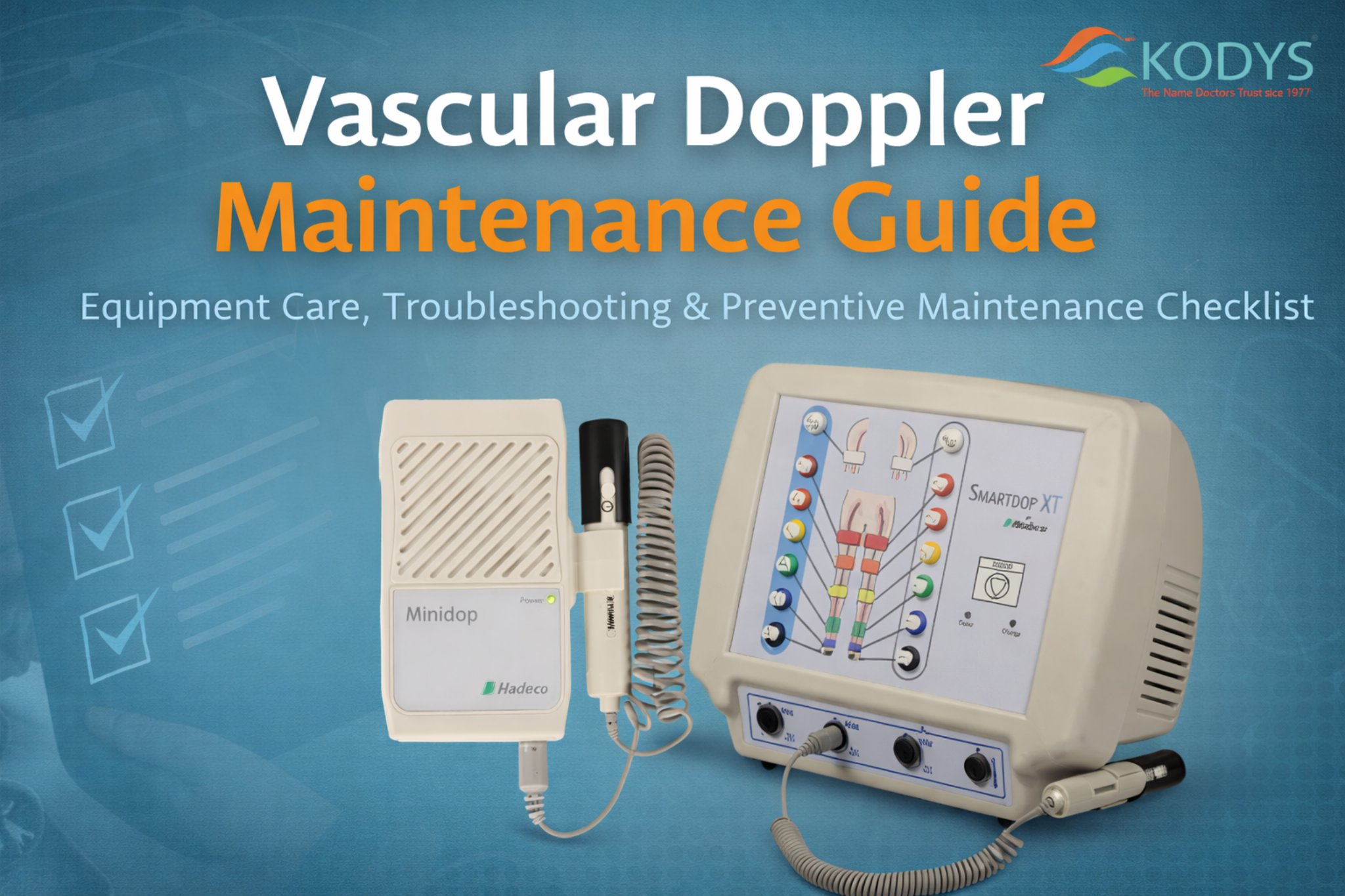
Introduction: Why Vascular Doppler Maintenance Matters
Vascular Doppler ultrasound machines are essential diagnostic tools in modern healthcare, used to evaluate blood flow velocity, detect arterial and venous disorders, and support cardiovascular screening. These advanced medical devices represent major investments for hospitals and clinics, making regular maintenance critical for long-term functionality, diagnostic accuracy, and patient safety.
The Doppler systems supplied by Kody Medical, including portable units like MINIDOP ES100VX and advanced models such as SMARTDOP XT14 PORT, require consistent care to preserve calibration accuracy, probe sensitivity, and diagnostic reliability. Poor maintenance can result in inaccurate readings, equipment breakdowns, higher repair costs, and compromised patient care.
Understanding Your Vascular Doppler Equipment
Before performing maintenance, it is essential to understand the main components of vascular Doppler machines:
- Transducers/Probes: Generate high-frequency ultrasound waves (4–20 MHz)
- LCD Display/Touchscreen: Displays waveforms and data
- Processing Unit: Includes CPU, FFT analyzer, and memory
- Power System: Battery- or AC-powered units
- Cable Connections: USB, PPG probe, and power cables
- Software Systems: Smart-V-Link and Smart-XT-Link
Understanding these components enables targeted troubleshooting and preventive care.
Weekly Maintenance Checklist
Probe Inspection:
Check for cracks, corrosion, cable damage, and audio clarity.
Screen Cleaning:
Clean the LCD/touchscreen using a lint-free cloth and approved solutions.
Speaker & Audio System:
Verify consistent sound output across frequencies.
Battery Check:
Monitor charge levels, connector cleanliness, and abnormal heating.
Software System:
Test waveform storage, USB connectivity, data export, and firmware updates.
Common Issues & Troubleshooting
No Signal Detection: Ensure secure probe connection, apply fresh gel, and recalibrate.
Weak Signal: Clean probe, replace gel, and inspect cables.
Display Errors: Restart the device, check connections, and update software.
Memory Errors: Clear storage, back up data, and update firmware.
Battery Issues: Replace batteries, clean connectors, and perform recharge cycles.
Probe Care & Storage Best Practices
The probe is the most sensitive component. Clean it after every use, remove gel residue, and store it vertically in a temperature-controlled environment (15–30°C, 30–70% humidity). Avoid direct sunlight and never apply heat for drying. Weekly deep cleaning and inspection prevent premature damage.
Calibration Procedures
Monthly calibration ensures diagnostic accuracy. Check waveform display, velocity ranges, baseline adjustments, and PPG functionality. Annual professional calibration is recommended for compliance, hospital accreditation, and long-term reliability.
Parts Replacement & Warranty Support
Common replacements include conductive gel, probe cables, batteries, USB cables, and PPG probe tips. Kody Medical equipment includes a 1–2 year warranty, with extended service contracts offering preventive maintenance, priority parts, and technical support.
Service Contact:
📧 kodymedical@gmail.com | 📞 +91-9380223396
Preventive Maintenance Schedule
- Monthly: Inspection, cleaning, backup, battery checks
- Quarterly: Deep probe cleaning, calibration testing, training
- Semi-Annual: Cable and display inspection
- Annual: Professional diagnostics, firmware upgrades, calibration
Conclusion: Maximizing Your Investment
Proper vascular Doppler maintenance ensures long-term reliability, accurate diagnostics, and improved patient outcomes. By following structured maintenance routines and leveraging Kody Medical’s service programs, healthcare providers can reduce downtime, control costs, and extend equipment lifespan—maximizing both clinical performance and return on investment.
Frequently Asked Questions (FAQs)
1. How often should vascular Doppler machines be maintained?
Vascular Doppler machines should undergo basic inspection and cleaning daily, weekly functional testing, monthly calibration checks, and annual professional servicing. Regular maintenance ensures accurate readings, extended equipment lifespan, and reliable diagnostic performance.
2. What are the most common problems in vascular Doppler ultrasound machines?
Common issues include weak or no signal detection, probe damage, display malfunctions, waveforms, waveform memory errors, and battery failures. Most of these problems can be prevented through proper cleaning, calibration, correct storage, and routine inspections.
3. How do I properly clean and store Doppler probes?
Clean probes daily using a soft, lint-free cloth and approved disinfectant. Remove all gel residue, avoid excessive moisture, allow natural drying, and store probes vertically in a temperature-controlled environment between 15 and 30°C with humidity levels of 30–70%.
4. When should vascular Doppler equipment be professionally calibrated?
Professional calibration is recommended annually or after major repairs, relocation, or abnormal readings. Regular calibration ensures diagnostic accuracy and compliance with hospital accreditation standards such as NABH and JCI.
5. Why is preventive maintenance important for Doppler ultrasound machines?
Preventive maintenance helps reduce breakdowns, improves equipment accuracy, minimizes downtime, extends system lifespan, ensures regulatory compliance, and protects long-term investment in medical diagnostic equipment.