kodymedical@gmail.com
 +91-9380223396
 My Account
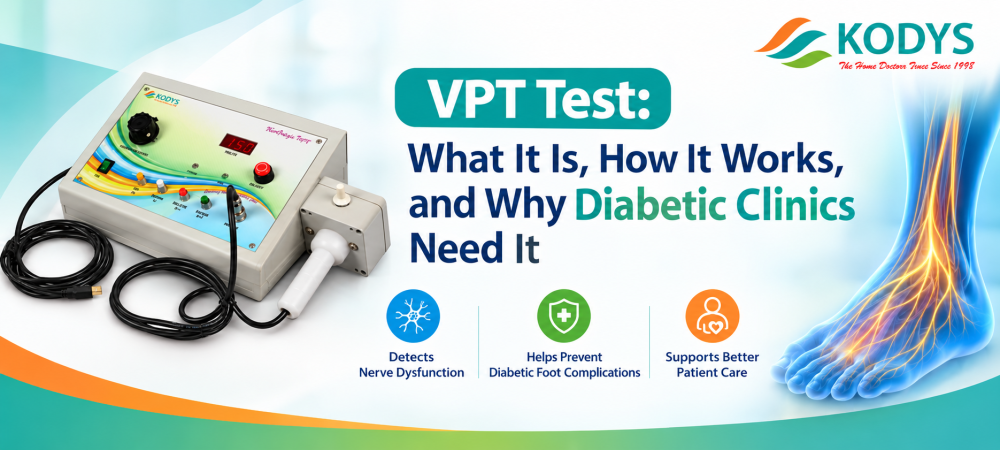
VPT stands for Vibration Perception Threshold. A VPT test is a painless, non-invasive nerve-function screening that measures how well a patient can feel vibration in the feet and hands, typically using a handheld device called a biothesiometer. It is the standard bedside test for detecting peripheral diabetic neuropathy before numbness, ulcers, or foot complications appear. This guide is brought to you by Kody Medical Electronics Pvt Ltd, a Chennai-based manufacturer of diabetic foot care and neuropathy diagnostic equipment for over 35 years, including the BIOTHEZI-VPT digital biothesiometer used by clinics across India for VPT testing.
VPT Full Form in Medical Terms
VPT stands for Vibration Perception Threshold, sometimes written as VPT test, VPT scan, or VPT screening depending on the clinic or region. The abbreviation itself is straightforward — “vibration” refers to the mechanical stimulus applied to the skin, “perception” refers to the patient’s ability to sense that stimulus, and “threshold” refers to the exact point at which sensation is first registered. Clinics occasionally pair the VPT test with the ABI test (Ankle-Brachial Index) to assess both nerve function and blood flow together during a diabetic foot check-up, since neuropathy and vascular disease often develop side by side in long-standing diabetes.
It is worth clarifying upfront: VPT is not a blood test. No sample is drawn and no laboratory processing is involved. It is a bedside neurological measurement performed directly in the consultation room, and it is usually completed in under five minutes per limb, which is why it fits easily into a routine diabetic OPD visit.
What Is a VPT Test, and What Does It Measure?
A VPT test measures the minimum vibration intensity a patient can perceive when a vibrating probe is placed on a bony point — most commonly the great toe, the medial malleolus (ankle bone), or a fingertip for upper-limb assessment. The result is expressed in volts, and a higher voltage needed before the patient feels the vibration indicates reduced nerve sensitivity at that site. The test specifically evaluates large-fibre sensory nerve function, which is typically the first type of nerve fibre affected in diabetic peripheral neuropathy.
Clinically, VPT testing is used to:
- Screen for diabetic peripheral neuropathy at an early, often reversible stage, before the patient notices any symptoms
- Assess risk of diabetic foot ulcers, since loss of protective sensation is the single biggest predictor of ulceration
- Monitor nerve damage progression over time by comparing readings across follow-up visits
- Support pre-surgical nerve assessments, occupational health screening, and insurance or disability evaluations where objective nerve function documentation is required
- Provide a quantifiable, repeatable number that can be tracked in the patient’s chart, unlike purely subjective symptom reporting
How Is the VPT Test Performed?
- The patient sits or lies comfortably with the test site (usually the foot) exposed and at rest.
- A biothesiometer probe is placed on the pulp of the great toe or the medial malleolus, held with light, even pressure.
- The device gradually increases vibration amplitude from zero, either automatically or via manual dial control depending on the model.
- The patient is asked to signal — usually by raising a hand or saying “yes” — the moment they first feel the vibration.
- The voltage at that exact point is recorded as the VPT value for that site.
- The test is repeated at multiple sites and on both feet, and sometimes on the hands, so the clinician can compare readings side-by-side and check for asymmetry.
No needles, no fasting, and no special preparation are required, which is why VPT testing is popular as a quick in-clinic diabetic screening tool, often performed alongside monofilament testing for a fuller sensory assessment. Monofilament testing checks protective sensation (light touch), while VPT testing checks vibratory sensation — together they give a more complete picture of large-fibre nerve function than either test alone.
VPT Test Normal Range
There is no single universal cutoff accepted worldwide, since normal values can shift slightly with age, testing site, and device calibration. That said, the ranges most commonly cited in clinical literature and used as a practical reference are:
| VPT Reading (volts) | Interpretation |
| Below 15V | Normal sensation |
| 15V – 25V | Mild to moderate sensory loss / at-risk |
| Above 25V | Significant sensory loss — high risk of foot ulceration |
A reading consistently above 25V is generally treated as a “VPT positive” result, meaning the patient shows measurable vibratory sensory loss consistent with peripheral neuropathy. Because thresholds can vary by a few volts between devices and testing protocols, clinics should always compare readings against the specific biothesiometer manufacturer’s reference chart rather than relying on a single generic number, and should track each patient’s own baseline over time to spot meaningful change.
What Does “VPT Positive” Mean?
“VPT positive” simply means the patient’s threshold exceeded the clinic’s normal cutoff — they needed an unusually high vibration intensity before they could feel the stimulus at all. This is considered an early, objective marker of diabetic neuropathy, and it often shows up on testing years before a patient ever reports numbness, tingling, or burning in the feet. A VPT-positive result typically prompts closer diabetic foot care, patient education on daily foot inspection, appropriate footwear advice, referral to podiatry where needed, and tighter attention to glycemic control, since better blood sugar management can slow further nerve damage.
VPT vs. ABI Test: What’s the Difference?
Patients and clinic staff often look up VPT and ABI testing together because both are commonly performed during the same diabetic foot assessment, but the two tests measure entirely different systems:
- VPT test — checks nerve function (sensory perception), identifying peripheral neuropathy
- ABI test — checks blood flow (vascular supply) by comparing blood pressure at the ankle against blood pressure at the arm
Used together, VPT and ABI give a fuller picture of overall diabetic foot risk: nerve damage (neuropathy) and poor circulation (peripheral vascular disease) are the two leading underlying causes of diabetic foot ulcers and, in advanced cases, amputation. A patient can have one problem without the other, so relying on just one test can miss real risk — which is why many diabetic foot protocols recommend both as a standard combined screening.
Why Diabetic Clinics Need a VPT Testing Protocol
For diabetology and endocrinology clinics, VPT testing isn’t an optional add-on — it is a core annual screening recommended for every diabetic patient under most diabetic foot care guidelines. A reliable biothesiometer lets a clinic:
- Detect neuropathy three to five years before clinical symptoms appear, when preventive steps are most effective
- Document objective, repeatable readings for patient records, referrals, and insurance documentation
- Reduce diabetic foot ulcer and amputation rates through earlier intervention and patient education
- Differentiate at-risk patients who need closer podiatry follow-up from those who can continue routine annual checks
- Standardize screening across doctors and staff, since the reading is a number rather than a subjective impression
Clinics evaluating equipment for this workflow can review the Digital Biothesiometer – BIOTHEZI-VPT range from Kody Medical, along with the KODYS VPT ULTRA (a large-fibre neuropathy analyser for foot and hand vibration studies) and KODYS HCP-ELITE (a hot/cold small-fibre analyser) for clinics looking to build out a complete neuropathy testing lab rather than relying on a single device.
VPT Test Cost in India
VPT test pricing varies by city, clinic type, and whether the test is bundled into a broader diabetic foot screening package. Standalone VPT tests at diagnostic centers and diabetology clinics in India are generally priced as an affordable point-of-care test rather than a lab-send-out test, since results are read instantly on the device with no waiting period for a report. Patients should confirm current pricing directly with their clinic, as it depends on location, the clinic’s equipment, and whether ABI or monofilament testing is included in the same visit.
Understanding a VPT Test Report
A typical VPT test report lists the voltage reading recorded at each tested site — usually both great toes, and sometimes the ankles or fingertips — alongside the clinic’s normal reference range, so the referring doctor can quickly see which sites, if any, are abnormal. Digital biothesiometers like the BIOTHEZI-VPT can generate a pictorial, graphical, colour-coded report and export it as a PDF, making it easy to file in the patient’s record, share with a specialist, or compare against a previous visit to track whether neuropathy is stable, improving, or progressing.
About Kody Medical
Kody Medical Electronics Pvt Ltd, based in Chennai, Tamil Nadu, has been manufacturing diabetic foot care, wound care, pain management, and diagnostic equipment for over 35 years. Kody Medical’s diabetic neuropathy range includes the BIOTHEZI-VPT and BIOTHEZI-VPT Lite digital biothesiometers for vibration perception threshold testing, the KODYS VPT ULTRA large-fibre neuropathy analyser, the KODYS HCP-ELITE hot/cold small-fibre neuropathy analyser, 10g monofilaments, and the KODYSCAN cardiac autonomic neuropathy analyser — alongside vascular Doppler systems, automatic ABI/TBI/PVR devices, and podiatry equipment. The company supplies hospitals, diabetology clinics, and diagnostic centres across India and works directly with clinics to plan a complete neuropathy screening setup based on patient volume and budget.
For product details or a quote on VPT testing equipment, reach out to Kody Medical or call +91-9380223396.
Frequently Asked Questions
What is VPT test in medical terms?
VPT (Vibration Perception Threshold) test is a nerve-function screening that measures a patient’s ability to sense vibration, used mainly to detect diabetic peripheral neuropathy.
What is the VPT medical abbreviation for? VPT is the medical abbreviation for Vibration Perception Threshold, the voltage level at which a patient first perceives a vibrating stimulus applied to the skin.
Is VPT a blood test?
No. VPT is not a blood test. It is a bedside vibration-sensation test performed with a biothesiometer, and no blood sample is needed.
What is a normal VPT test range?
Readings below 15V are typically considered normal; readings above 25V are generally flagged as abnormal, or “VPT positive,” indicating sensory nerve loss.
What does VPT positive mean?
It means the patient’s vibration perception threshold was higher than the normal cutoff, indicating measurable nerve sensory loss — an early sign of diabetic neuropathy.
Who should get a VPT test?
Anyone with type 1 or type 2 diabetes, especially those who have had diabetes for more than five years, should have annual VPT screening as part of routine diabetic foot care.
What does a VPT test report show?
A VPT test report shows the voltage reading at each tested site, compared against the clinic’s normal reference range, so the doctor can see whether nerve sensation is normal, at-risk, or significantly reduced.