kodymedical@gmail.com
 +91-9380223396
 My Account

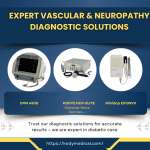
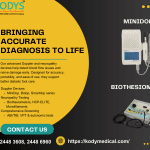
A hand-held Doppler is a compact ultrasound device designed to measure blood flow using high-frequency sound waves. Unlike larger lab machines, these portable devices fit easily into a pocket and provide real-time audio or visual output directly at the patient’s bedside. They are used to measure blood flow through arteries and veins, enabling quick screening of blood circulation or fetal heart activity in various settings. For example, the Kody Medical ES-100VX Mini Doppler is a cost-effective pocket Doppler with an integrated speaker for detecting pedal pulses, ankle pressures, or fetal heart sounds. The larger Bidop ES100V3 model includes a backlit LCD for live Doppler waveforms and can store up to 30 readings for reporting. Essentially, modern handheld Dopplers provide powerful ultrasound capabilities directly into the clinician’s hand.
Key Benefits of Handheld Doppler Devices
Portability & Accessibility: These lightweight, battery-powered devices allow clinicians to perform Doppler scans anywhere, from the emergency room to a patient’s home. This mobility makes ultrasound more accessible and efficient, particularly in rural or resource-limited areas.
Immediate Bedside Diagnostics: Handheld Dopplers offer instant feedback through audible signals and/or waveforms, eliminating the need to wait for off-site imaging. This enables doctors to scan a patient and get immediate results, leading to faster intervention. Such rapid feedback can be life-saving in critical cases.
Enhanced Patient Comfort: By bringing diagnostics to the bedside, portable Dopplers reduce the stress on patients who might otherwise need to travel to distant labs. This is particularly beneficial for the elderly or infirm, improving convenience and compliance with necessary vascular checks.
Cost-Effective Vascular Screening: Research indicates that audible Doppler is a simple, rapid, and inexpensive bedside test for peripheral arterial disease (PAD). In diabetic foot care and vascular clinics, handheld Dopplers can reliably screen for circulatory problems without costly referrals, serving as an ideal first-line tool for detecting PAD and monitoring wound healing due to their low cost and ease of use.
Non-Invasive & Easy to Use: Doppler scans are non-invasive, involving no radiation or needles. Most devices are user-friendly, often with a simple probe and speaker/display, requiring minimal setup. This design allows non-specialists, such as nurses, midwives, or technicians, to perform quick vascular or fetal assessments.
Applications Across Healthcare Settings
Handheld Dopplers are utilized across a wide range of care environments:
Hospitals & Multi-Specialty Clinics: These devices are integral in emergency rooms, operating theaters, obstetric wards, and vascular labs. Trauma teams and ER physicians use them for rapid assessment of circulation in injured limbs or to triage shock patients. Obstetricians and labor units use them as non-invasive fetal monitors for tracking fetal and placental blood flow. Cardiologists and vascular surgeons also rely on pocket Dopplers for evaluating pulses and murmurs during routine screenings, enhancing diagnostic speed and precision for vascular conditions.
Nursing Homes & Rehabilitation Centers: In long-term care, Dopplers help track peripheral circulation and wound healing. Nurses can use them during daily rounds to check limb pulses or ABI/TBI levels at the bedside. Early PAD detection is crucial for preventing ulcers or gangrene in elderly patients. The non-invasive, at-the-point-of-care use is especially valuable for immobile patients or those with multiple comorbidities.
Independent Physicians & Small Clinics: General practitioners, podiatrists, and specialists in smaller clinics use pocket Dopplers for routine vascular exams. For instance, a family doctor might listen to pedal or dorsalis pedis pulses during a diabetes check-up, eliminating the need to send the patient to an imaging center. Similarly, OB-GYNs in private practice use fetal Dopplers for prenatal visits, allowing many diagnoses to begin directly in the clinic and improving care continuity.
Home Healthcare Providers: Visiting nurses, midwives, and home health aides frequently carry portable Dopplers. These devices facilitate home-based prenatal check-ups (monitoring fetal heartbeats) and vascular assessments (e.g., checking foot pulses in diabetic patients or verifying IV cannulation with Doppler guidance). This quick, bedside data empowers home health teams to detect issues early and coordinate timely care without moving the patient.
Medical Equipment Dealers & Distributors: Dealers and distributors stock handheld Dopplers due to their universal clinical utility. These products appeal to a broad market, from rural clinics to urban hospitals, and are often bundled with other vascular or obstetric equipment. By offering portable Dopplers, distributors can provide comprehensive diagnostic solutions for cardiovascular, diabetic, and maternal health markets.
Government Health Agencies & NGOs: Public health programs and nonprofit clinics deploy handheld Dopplers for community screenings and rural outreach. Portable ultrasound devices have been instrumental in bridging healthcare gaps in underserved areas. In village health camps or NGO maternal clinics, mobile Dopplers enable early detection of high-risk pregnancies and peripheral artery disease. Governments also use them in blood pressure or diabetes screening initiatives for rapid assessment of circulation in large populations.
Medical & Nursing Education: Teaching hospitals and training schools integrate handheld Dopplers into their curricula. Students learn basic ultrasound and Doppler principles by using these devices to detect pulses and heartbeats. This practical training helps future clinicians become proficient in Doppler waveform interpretation and bedside diagnostics, ensuring a skilled workforce as Doppler use expands.
Corporate Wellness Programs: Many employers and occupational health programs now incorporate vascular screening into their preventive exams. Onsite health officers use portable Dopplers to quickly check employees’ limb circulation or screen pregnant staff. Handheld Dopplers simplify brief cardiovascular risk assessments during annual check-ups, enhancing employee health surveillance.
Diagnostic Labs & Imaging Centers: Outpatient labs and imaging clinics use handheld Dopplers as a front-line screening tool. Before ordering full ultrasounds or angiograms, clinicians can use a portable Doppler to rule out obvious vascular insufficiency, saving time and costs. Some clinics also use pocket Dopplers during ultrasound preparation, for example, to locate blood flow before a detailed scan.
Palliative Care & Elderly Care: In palliative and geriatric settings, patient comfort is paramount. Handheld Dopplers allow non-intrusive monitoring of circulation for bedridden or terminal patients. Care teams can assess arterial pulses or venous flow at the bedside without disturbing fragile patients, helping clinicians adjust pain management or monitor peripheral vascular status with minimal patient stress.
Why Choose Kody Medical’s Handheld Dopplers
Kody Medical Electronics has over 35 years of experience in designing diagnostic equipment. Their Doppler products are manufactured in India to stringent quality standards, ensuring reliability and accuracy. Kody Medical offers a range of handheld vascular Doppler machines, such as the ES-100VX and Bidop ES100V3, which combine proven technology with user-friendly features. Each Kody Doppler includes multi-frequency probes (5/8/10 MHz) to cater to diverse needs, from limb pulse checks to fetal monitoring. Additionally, their devices can integrate with reporting software for effortless documentation of waveforms and patient data.
Kody Medical’s handheld Dopplers are designed to deliver the necessary performance for high-tech hospitals and remote clinics alike. These modern portable Dopplers enhance diagnostic speed and precision for vascular care while making ultrasound accessible outside the radiology suite. Kody Medical supports its products with dedicated service, training, and technical support. By choosing Kody’s Doppler solutions, healthcare providers gain a trusted, high-quality tool to improve patient outcomes.
Explore Kody Medical’s Vascular Doppler product range to find the right handheld Doppler device for your facility. With Kody Medical’s equipment, you can perform faster vascular and fetal assessments in virtually any care setting, thereby enhancing diagnostics, lowering costs, and ultimately improving patient care.