kodymedical@gmail.com
 +91-9380223396
 My Account
Vascular Doppler ultrasound and diabetic neuropathy testing are of utmost importance in modern medicine. Using high-frequency sound waves, Doppler instruments perform a noninvasive assessment of blood flowing through arteries and veins, focusing chiefly on peripheral screens. Neuropathy tests assess nerve function and sensation. Neuropathy begins with a soft approach in diabetic patients. A simple test of vibration, temperature, pain, or reflex function could detect neuropathy in its early stages. Early detection of these problems may be linked to preventing foot ulcers or amputation.
Understanding how the system actually works is helpful for both doctor and patient. Doppler examinations use a hand-held probe to emit ultrasound signals while being placed over arterial pulses—pulses over the ankle or wrist. These signal reflections produce audible pulses or waveforms for the clinician. Ankle-brachial index (ABI) and toe-brachial index (TBI) are additional measurements that compare blood pressures at the foot versus the arm to quantify flow. Neuropathy assessments employ instruments such as vibrating probes (biothesiometers), nylon monofilaments, or cool-hot stimulators to measure nerve thresholds. For instance, the biothesiometer slowly increases the vibration on the skin until the patient actually feels it, measuring the Vibration Perception Threshold (VPT). These tests are fairly simple and quick and are documented so they can be used to assist with medical treatment.
Doppler Ultrasound Testing
What is Doppler ultrasound?
Vascular Doppler utilizes sound waves to measure the speed and direction of blood flow. It is essentially an ultrasound probe that senses movements of red blood cells. The clinician places a probe on the skin above an artery and is able to hear the pulse as well as see a waveform trace. Because of its noninvasive and instantaneous nature, Doppler evaluation is standard for foot and ankle care for diabetic patients and for anyone who has leg pain. They assist with diagnosing peripheral artery disease or malperfusion.
How is a Doppler Exam Conducted?
A typical test takes place either bedside or in the clinic room while the patient remains lying down. Sometimes a blood pressure cuff is wrapped around the ankle or toe; a little gel is placed on the skin, and the operator slides the Doppler probe until pulses are heard in the foot (dorsalis pedis or posterior tibial artery). A speaker sends the whooshing flow sounds to the physician. While the in-built LCD screen shows the flow waveform. The system then proceeds to record the systolic pressure at the ankle with respect to the arm or at the toe. Most modern devices automate this process. According to a foot care clinic manual, “Vascular Doppler is a non-invasive test to assess the bloodstream, especially in the foot and in the leg, by sending ultrasound through the arteries and veins.”
Kody Medical’s Doppler Devices:
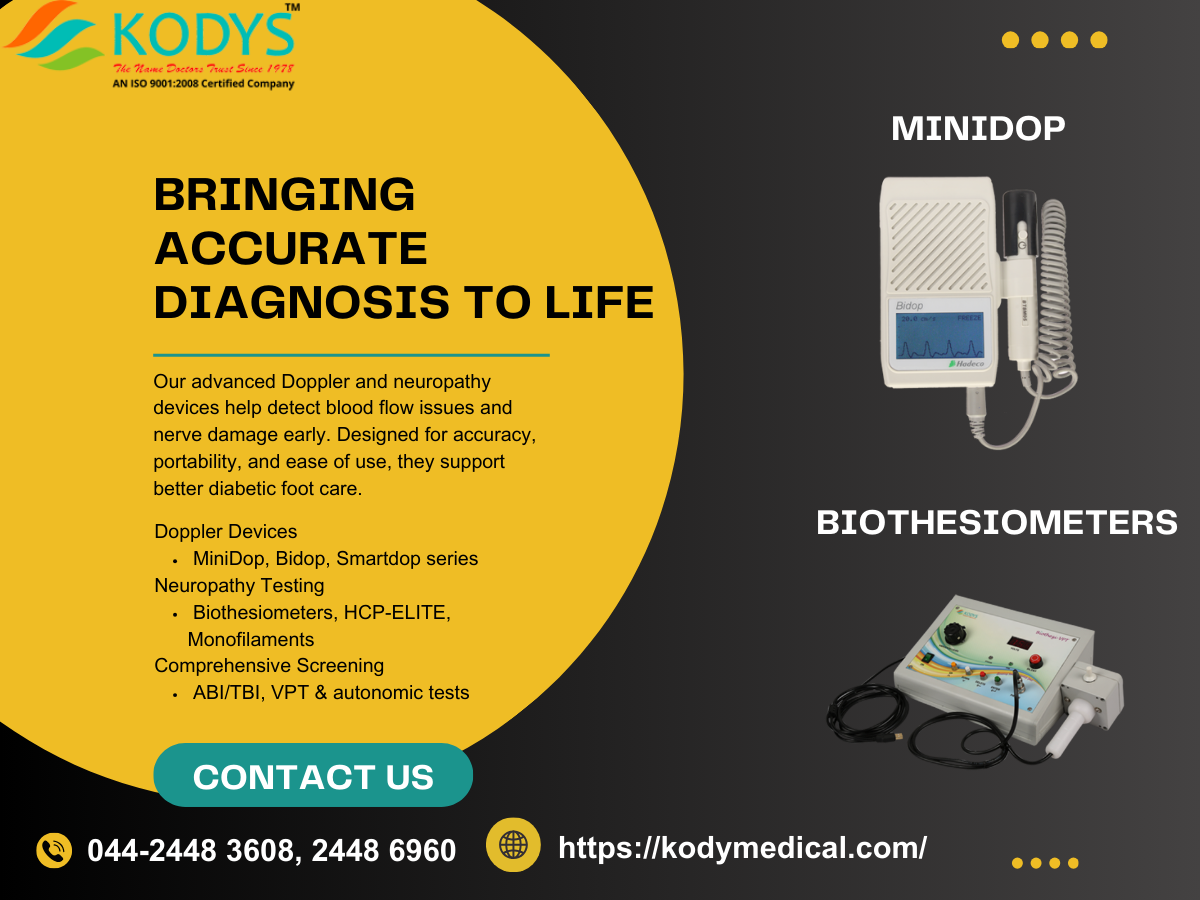
- Minidop ES100VX is a small, pocket Doppler with a multi-frequency probe (5, 8, 10 MHz) and a built-in speaker. This is especially affordable and is the tool of choice for the location of pedal pulses, measurement of systolic pressures, or just listening to the fetal heartbeat.
- Bidop ES100V3 is a bidirectional pocket Doppler and waveform display unit. It displays a real-time arterial waveform on the LCD and can store up to 30 waveforms for later review. Also, it has USB connectivity options to attach to software for reporting. Additional options include a photoplethysmography (PPG) toe probe for measuring toe pressures. Real-time visualization and tracing of flow changes are made easy.
- Smartdop 45: More of a one-button handheld Doppler with integrated printer and waveform LCD as opposed to an interface for basic test settings. The automatic gain/baseline and USB interface definitely make testing efficient. Optional modules such as a PPG probe (toe pressure) may be wired into the device. In practical use, a provider could lock in gain fairly rapidly and print a waveform report for reimbursement by capturing arterial and venous signals.
- Bidop 7: Bi-directional Doppler, having a color LCD with real-time waveforms and numerical blood velocity values. It is very sensitive and has a wide Doppler beam, and peak and mean velocity measurements of arterial and venous flows are possible. Data exportation is possible through USB for analysis (e.g., by FFT analysis using Kody’s Smart-VLink software). A subtle level of detail provides the physician with a quantifiable understanding of blood flow in which abnormalities can be detected.
- Smartdop XT (6-Port and 14-Port): These are fully automatic vascular testing systems for comprehensive ABI/TBI and PVR studies. Six ports can take automatic blood pressure and volume measurements for up to 6 limb sites (e.g., both arms, ankles, and toes) at the press of a single button. Fourteen ports mean 14 sites directed at large clinics. Both systems work with cuffs and PPG sensors whose software (Smart XT Link) calculates ABI and TBI as well as carries out venous reflux studies. Automatic manual machines reduce the duration of the exam and the chance of operator mistakes.
- Smartdop 30EX: A Doppler and cuff inflator combined in one box, specifically designed for ABI/TBI testing. It will compute ankle and toe indices automatically and print a report to that effect. It has two inputs for probes and can display/print velocity waveforms and pressures. It is very much oriented toward the quick and reproducible arterial studies of highly susceptible diabetic patients.
- DVM 4500: This is the most expensive type of table-level Doppler with a 10-inch color touchscreen. It supports 2 interchangeable probes (4–20 MHz) and also an optional PPG. It stores up to 30 waveforms internally and can export data in PDF or DICOM format. Given its FFT analysis and fast CPU, it is very useful in vascular or surgical suites where detailed waveform and multi-frequency capability are required.
All these instruments are portable and user-friendly. For instance, the very handy Minidop and Bidop models run on batteries and are about the size of a smartphone. Features like automated gain controls and snap-lock probe connectors lessen the effort required from the operator. Clinicians actually use these machines to find weak pulses, calculate ABI/TBI, and monitor blood flow changes. As Kody observes, Doppler machines “will give waveform display and audio output in real time, thereby helping clinicians localize pulses.” These noninvasive Dopplers thus help to screen for abnormal flow and perfusion.
Diabetic Neuropathy Testing
What is Diabetic Neuropathy?
Diabetic neuropathy defines nerve damage caused by diabetes, especially in the feet and legs. It starts with a loss of sensation (numbness) or painful sensations. This is a very common complication: Kody Medical stresses that diabetic peripheral neuropathy “causes neuropathic pain, diabetic foot ulcers, and lower limb amputations” if it is not repaired forthwith. The sooner neuropathy is detected, the better. Unfortunately, simple tests like nerve conduction studies or monofilament touch mostly begin detecting problems when damage is already advanced. By this time, protective sensation is lost.
How Are Neuropathy Tests Conducted?
Neuropathy exams measure different nerve functions:
- Vibration Testing: A biothesiometer consists of a vibrator connected to a main unit. The probe is positioned on the patient’s toe or finger, and vibration is gradually increased until sensation is felt. The vibration thresholds, in volts or microns, for example, indicate the health, or lack thereof, of the large-fiber nerves. The higher the threshold, the worse the neuropathy. The tests are carried out on both feet and occasionally on both hands to detect symmetric neuropathy.
- Monofilament Testing: A stiff 10-gram monofilament is applied to various points on the plantar surface. An inability of the patient to feel the bending of the filament at one or more sites renders that foot “at risk” for ulcerations. It remains a very simple, low-tech method but is positive only once the nerves have undergone quite substantial impairment.
- Thermal/Pain Testing: Small-fiber nerves are tested with a heat/cold/pain device (sometimes called HCP). Kody’s KODYS HCP-ELITE, for instance, applies either warm or cool stimuli in a controlled manner and then requires patients to self-report the temperature or painful sensation perceived. Most loss of hot/cold perception is initially observed in neuropathy; hence, these tests can probe early small-fiber injury before the loss of vibratory sensation.
- Autonomic Testing: Diabetes can also involve the autonomic nerves (such as modulating heart rate and blood pressure). Cardiac autonomic neuropathy (CAN) tests evaluate the variability of heart rate (HRV) while performing certain maneuvers (from lying down to standing up, deep breathing, etc.). A Kody device, KODYSCAN, is used to record ECG and blood pressure changes to assess ANS functions. Lower HRV can give early indications of autonomic neuropathy.
Each test is generally a brief one (seconds to minutes) and non-invasive. To illustrate, vibration testing might last 10–15 seconds per foot. The data available, whether numerical thresholds, waveforms, or a note of sensation, are recorded. This provides a quantitative baseline against which further testing can be measured over time.
Kody Medical’s Neuropathy Devices:
- Digital Biothesiometers (BIOTHEZI-VPT, VPT Lite): The devices measure Vibration Perception Threshold. The BIOTHEZI-VPT comes equipped with a digital display and USB output. The patient simply places the foot on the sensor, and the device begins ramping vibration. The BIOTHEZI-VPT Lite is a lighter, portable version. Both produce pictorial/graphical reports and can export PDF summaries. Kody says that they are “simple and economical” and have manual control over vibration, which enables them to reach the precise threshold faster. The range is up to 25 microns displacement (at 100 Hz). By quantifying Vibration Perception Threshold (VPT), clinicians can assess the risk of neuropathy.:Increased values equal increased nerve loss.
- KODYS HCP-ELITE: The next-generation neuropathy analyzer for the hot/cold/pain test. It has a bi-color display (red=heat, green=cool) and computer interfaces (USB/Bluetooth). Depending on the temperature stimulus applied, the tester registers the temperature at which the subject feels warm or cold. Since small-fiber involvement usually shows in the early stages of neuropathies, it can diagnose the neuropathic conditions earlier than vibration.
- KODYS VPT ULTRA: This sophisticated biothesiometer for large-fiber neuropathy, designed for use on both the foot and hand, provides Bluetooth connectivity and smartphone app control, ensuring maximum flexibility in screening. Like the conventional biothesiometers, it measures vibration threshold and gives graphical reports.
- Monofilaments: Kody supplied packs of 20 reusable, 10-gram monofilaments. These are the classic nylon filaments (sized 5.07) used to test protective sensation at 16 sites on the feet. It is the very basis for neuropathy screening.
- KODYSCAN (Cardiac Autonomic Neuropathy Analyzer): This is a fully automated CAN testing system. It places BP cuffs on patients and ECG electrodes. The machine measures heart rate variability and BP response to tests (deep breathing or Valsalva). It calculates indices of autonomic balance (sympathetic vs. parasympathetic). Impaired autonomic function is a grave yet neglected dimension of diabetic neuropathy.
According to Kody, these neuropathy devices produce early detection. Kody’s blog notes the following about digital biothesiometers and heat/cold analyzers: “They measure VPT in large fibers and HCP in small fibers… much earlier diagnosis of diabetic neuropathy than nerve conduction studies is thus possible.” Catching the changes early allows physicians to enhance foot care and glycemic control to halt further ulcerations and amputations.
Supporting Early Diagnosis and Patient Care
The pair of Doppler and neuropathy tests provides a more complete picture of diabetic foot health. Dopplers can diagnose circulatory problems before tissue loss, and neuropathy devices can identify nerve damage earlier than a patient would ever notice it. Kody’s devices hold this principle by being user-friendly and quantitative. For instance, a handheld Doppler or digital biothesiometer gives a quantitative result, which is usually printed out for documentation. Later, this data can be compared for changes over time or shared with patients to help them understand the urgency of intervention.
Fortunately, these are almost always short and noninvasive and can be performed during routine visits. The studies Kody mentions stated that vibration testing is “a simple method of finding large-fiber dysfunction” and can pick up at-risk patients. Similarly, foot clinics say Doppler exams are “accurate” with “quick results” to ascertain circulatory problems.
These technologies can be combined, thereby allowing clinics to establish a screening program for foot care. For instance, at each annual examination, a diabetic patient may have an ABI or TBI Doppler performed, along with vibratory testing. In situations where a test result indicates that something is wrong (e.g., ABI <0.9 or VPT above normal), the patient may be referred to either vascular or podiatry specialists, and protective measures put in place, such as custom shoes and foot education for wound care. Kody’s foot clinic software even incorporates all of these tests into a single system, making workflow easier.
To sum it up, Doppler ultrasound and neuropathy analyzers had complementary uses. Doppler systems such as MiniDop and Smartdop are therefore used for early detection of peripheral vascular diseases, whereas the neuropathy devices such as biothesiometers and thermotest apparatus detect nerve damage prior to the formation of ulcers. Thus, they provide the ground for preventive care in diabetes. Kody Medical’s range—from portable handheld Dopplers to automated ABI systems and simple monofilaments to complex neuropathy analyzers—is made purposely to ensure that these tests reach clinics. Healthcare practitioners can improve patient outcomes through their use, prevent complications, and finally, “vastly improve the quality of life for patients with diabetes.”