kodymedical@gmail.com
 +91-9380223396
 My Account

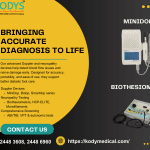
Handheld Dopplers, as they are also called, are pocket-sized, portable ultrasound devices that use high-pitched sound waves to aid in the detection of blood flow and heartbeat at the point of care. Kody Dopplers are intended for vascular studies as well as for fetal monitoring (detecting fetal heartbeats). For example, the Minidop ES-100VX can literally fit in a pocket with a built-in speaker to listen to pedal pulses, ankle pressures, or fetal heart sounds. Its multi-frequency probe (5, 8, and 10 MHz) allows for arterial, venous, and fetal monitoring. On the other hand, advanced vascular Dopplers like Bidop ES100V3 or Bidop 7 add visual displays on their LCDs and log data. Kody Dopplers are battery-powered, thereby allowing complete portability, and are even medically safe (ES100VX “conforms to IEC 60601-1” for electrical safety). Handheld devices have proven a blessing in enabling doctors and home-health providers to do non-invasive checks anytime, anywhere—from hospitals out to rural homes—without needle pricks or radiation.
Vascular Handheld Dopplers
Designed to check pulses in limbs and blood flow, vascular Doppler devices come in various specifications. Kody offers multiple handheld models with differences between simple audio-only units (like the ES-100VX) and complex units with display and analysis. For example, the Bidop ES100V3 is a handy, bidirectional Doppler displaying a believably hard-to-read real-time waveform on its backlit LCD and can save up to 30 waveforms. Taking it a step further, the Bidop7 brings along a full-color LCD and numerical readouts, as well as USB connectivity for data transfer. These are most commonly employed in vascular clinics, diabetic footwork settings, and by cardiologists. They permit measurements like Ankle-Brachial Index (ABI) or Toe-Brachial Index (TBI) to detect circulation problems, and comparing the pressures of the limbs offers them a definite diagnosis regarding peripheral artery disease (PAD). In fact, Kody mentioned, “Audible Doppler is a simple, rapid, and inexpensive bedside test for peripheral arterial disease,” thus making handheld units a perfect initial screening device in any setting.
Key features of Kody’s vascular Doppler models include:
- Waveform Display & Memory – Some mid-range models such as Bidop ES100V3, Smartdop 45, and Bidop 7 offer real-time Doppler waveforms on their LCDs. They can store dozens of waveforms (e.g., 30 memories) to be reviewed or reported later.
- Integrated Printer – The Smartdop 45 and Smartdop 30EX include integrated printers that print blood flow waveforms and pressures onto paper, useful for documentation and reimbursement.
- Automated Cuff & ABI/TBI – Units such as the Smartdop 30EX have automated blood pressure cuffs, which allow for one-button operation for ABI and TBI. This feature would help to streamline routine vascular exams in clinics.
- Advanced Probes & Accessories – Vascular probes are also multifrequency (5/8/10 MHz). Other keys to accessories are flat vascular probes that lie flat for hands-free use and PPG toe probes for toe pressure testing. Flat probes and photoplethysmography (PPG) modules enhance testing capabilities in the lab setup.
- Connectivity & Software – Higher-end models offer a USB interface to Kody’s Smart-V-Link software (Windows), which can store data for further analysis. This allows exporting of waveforms, patient reports, and integration with medical record systems.
Vascular Dopplers, although still considered portable, tend to be larger than fetal-only units. For example, the Smartdop 45 is a bit heavier and includes a rechargeable battery pack (NiMH) with an AC adapter, while the rest of the vascular units are designed to prioritize point-of-care use—easy automatic gain/baseline operation with a single button and comfortable grips. They are employed by doctors, nurses, and vascular technicians to quickly locate pulses (e.g., dorsalis pedis, posterior tibial) and to assess blood flow. In diabetic clinics, such units help prevent the onset of complications by early detection of incidences of poor circulation. Referring to their site, the Kody Corporation asserts the instance of a handheld vascular Doppler being “a noninvasive instrument used for the screening of altered blood flow to search for pulses or measure perfusion.”
Key Differences
- Intended Use: Fetal Dopplers are for detecting prenatal heartbeats (prenatal checkups, obstetric clinics, home monitoring by midwives). Vascular Dopplers are concerned with circulation and pulse in limbs (vascular labs, diabetic foot care, ERs). And in actual practice, most Kody devices are dual-use, although the main difference lies in the context of use.
- Display & Output: Fetal Dopplers, like the Minidop ES100VX, cannot visualize waves; the output is audio-only via a speaker. In contrast, vascular Dopplers commonly have an LCD (backlit or color) to visualize waveforms, and some even print or store the output readings.
- Probes: All Kody hand-held Dopplers use multifrequency (5, 8, and 10 MHz) bidirectional probes. For vascular usage, optional specialized probes are offered (flat probe, PPG toe probes). The typical probe is used for fetal work.
- Portability/Power: Both categories are battery-operated for easy portability. Simple models use DC batteries (9V) for less weight. Advanced models (Smartdop 30EX, Smartdop 45) use rechargeable NiMH battery packs and have power adapters so they can be used indoors as well. Both types are designed to be pocket-sized or desk-sized for easy transportation.
- Certifications & Quality: According to Kody, it is made by reputed quality manufacturing (India made to “stringent quality standards”). The MiniDop ES100VX claims to conform to IEC 60601-1 (medical device safety standard). All dopplers work based on non-invasive principles and do not require any special safety clearance other than electrical standards.
- Software & Reporting: Vascular Dopplers (such as the Bidop7 and Smartdop series) will export data via Kody’s Smart-V-Link/Smart-XT software for reporting purposes.
Frequently Asked Questions
1. What is a handheld Doppler, and what is it used for?
A handheld Doppler is a portable ultrasound device that uses high-frequency sound waves to detect blood flow and heartbeats. Kody Dopplers are used for vascular studies (checking limb circulation) and fetal monitoring (detecting fetal heartbeats) in hospitals, clinics, and home-care settings.
2. What is the difference between fetal Dopplers and vascular Dopplers?
Fetal Dopplers are mainly used to listen to a baby’s heartbeat and usually provide audio output only. Vascular Dopplers are designed to assess blood flow in limbs, often featuring LCD displays, waveform visualization, data storage, and tools to measure ABI or TBI for diagnosing circulation issues.
3. Are Kody handheld Dopplers safe for home and clinical use?
Yes. Kody Dopplers are non-invasive, radiation-free, and needle-free devices. Models like the MiniDop ES100VX conform to IEC 60601-1 medical electrical safety standards, making them safe for use by doctors, nurses, midwives, and trained home-health providers when used as instructed.
4. Can these Dopplers help detect peripheral artery disease (PAD)?
Absolutely. Vascular Dopplers are widely used as a first-line screening tool for PAD. They help measure the Ankle-Brachial Index (ABI) or Toe-Brachial Index (TBI), allowing clinicians to identify reduced blood flow and circulation problems early, especially in diabetic and vascular patients.
5. Do I need special training to operate a handheld Doppler?
Basic operation is simple, as most Kody Dopplers feature one-button controls, automatic gain, and clear audio or visual outputs. While non-specialists can use them, basic training is recommended for correct probe placement and accurate interpretation of waveforms or readings, especially in clinical diagnostics.