kodymedical@gmail.com
 +91-9380223396
 My Account
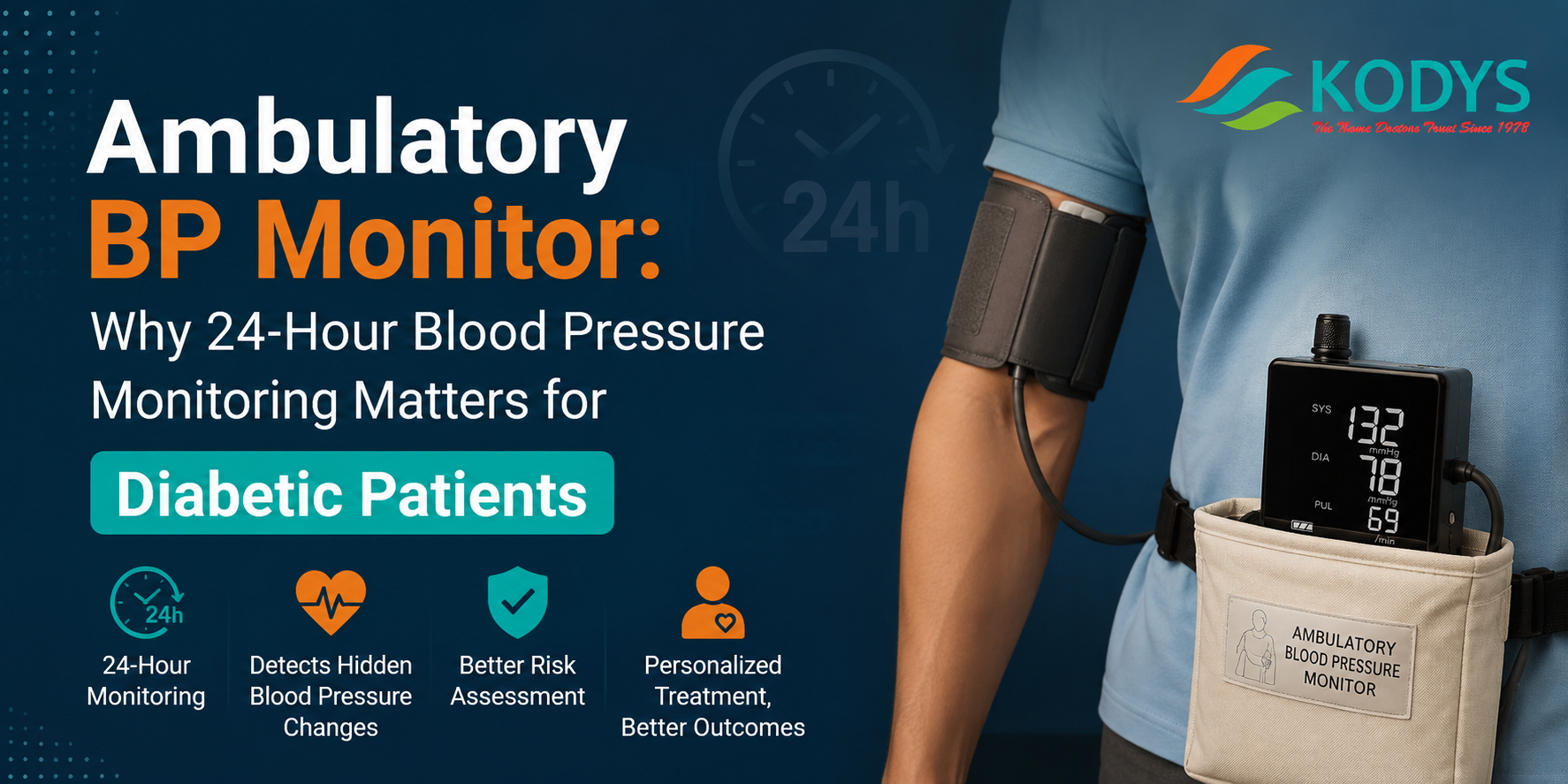
Ambulatory blood pressure monitoring (ABPM) records a patient’s blood pressure automatically over a full 24-hour period as they go about normal daily activity, rather than relying on a single in-clinic reading. For diabetic patients, this distinction matters enormously: hypertension and diabetes frequently coexist, and standard office BP checks routinely miss the nighttime and activity-driven blood pressure patterns that drive cardiovascular and kidney complications in this population. Kody Medical supplies A&D Japan’s ambulatory BP monitoring systems to diabetic clinics and hospitals across India for exactly this kind of continuous, clinically actionable monitoring.
Why a Single Office Reading Isn’t Enough
A one-time clinic BP reading captures a single moment, often during the stress of a doctor’s visit, a phenomenon known as “white-coat hypertension.” It can just as easily miss masked hypertension, where blood pressure is normal in the clinic but elevated during normal daily life. Diabetic patients are particularly prone to a third pattern called nocturnal non-dipping, where blood pressure fails to drop normally during sleep. Non-dipping is strongly associated with diabetic nephropathy progression, retinopathy, and elevated cardiovascular risk, yet it is invisible to a standard office check and only shows up through continuous monitoring.
How Ambulatory BP Monitors Like the A&D TM-2441 and TM-2440 Work
Devices such as A&D Japan’s TM-2441 and TM-2440, supplied by Kody Medical, are worn by the patient for 24 hours, automatically inflating and recording blood pressure at set intervals throughout the day and night. The TM-2441 is built as an all-in-one model, recording not just BP but environmental data such as temperature, pressure, and activity through a multi-sensor system while also capturing pulse waveform data during each measurement for more precise irregular-pulse detection. The TM-2440 is positioned as a simpler, entry-level ABPM device with a compact body and a built-in Irregular Heartbeat (IHB) detection function, making it suitable for routine ABPM screening and research use. Both models include bundled analysis software and USB connectivity, so readings can be downloaded, reviewed as a 24-hour profile, and printed into a clinical report rather than read off the device manually.
What 24-Hour Data Reveals That a Single Reading Cannot
Continuous ABPM data lets a clinician see the full blood pressure curve across a day, morning surge patterns, daytime variability, and the critical nighttime dip (or lack of one). For diabetic patients specifically, this data helps identify three things a single reading cannot: whether nocturnal blood pressure is dropping appropriately, whether irregular pulse waves are present during measurement, and whether prescribed antihypertensive medication is actually controlling pressure around the clock rather than only at the time of day a patient happens to visit the clinic.
Who Should Be Monitored With ABPM
Ambulatory BP monitoring is particularly valuable for diabetic patients with borderline or inconsistent office BP readings, patients already diagnosed with hypertension whose medication needs dose verification, and patients being screened for diabetic kidney disease, where nocturnal blood pressure patterns are an established risk marker. Diabetology clinics, nephrology units, and general physicians managing long-term diabetic patients are the primary settings where 24-hour ABPM adds the most diagnostic value over routine office checks.
Frequently Asked Questions
What is ambulatory blood pressure monitoring (ABPM)?
ABPM is a method of recording blood pressure automatically at regular intervals over 24 hours using a wearable device, rather than taking a single reading in a clinic. It captures daytime, nighttime, and activity-related blood pressure patterns that a single office visit cannot.
Why is ABPM especially important for diabetic patients?
Diabetic patients are at higher risk of nocturnal non-dipping, where blood pressure doesn’t fall normally during sleep, a pattern linked to diabetic kidney disease and cardiovascular complications. This pattern is only detectable through continuous 24-hour monitoring, not a single clinic reading.
What is the difference between the A&D TM-2441 and TM-2440 ambulatory BP monitors?
The TM-2441 is an all-in-one model that also records environmental and activity data alongside blood pressure and pulse waveforms. The TM-2440 is a more compact, entry-level ABPM device with built-in irregular heartbeat detection, designed for straightforward 24-hour BP monitoring.
What is nocturnal non-dipping, and why does it matter in diabetes?
Non-dipping occurs when blood pressure fails to drop by the expected amount during sleep. In diabetic patients, it’s associated with faster progression of kidney disease and higher cardiovascular risk, making it an important pattern to detect early through ABPM.
How long does a typical ambulatory BP monitoring session last?
A standard ABPM session runs for 24 continuous hours, during which the device automatically takes blood pressure readings at preset intervals during both waking and sleeping periods, then generates a full report for clinical review.
Who supplies ambulatory BP monitors in India for diabetic clinics?
Kody Medical supplies A&D Japan’s TM-2441 and TM-2440 ambulatory blood pressure monitors to diabetic clinics, hospitals, and diagnostic centers across India, along with bundled analysis software for 24-hour BP reporting.