kodymedical@gmail.com
 +91-9380223396
 My Account
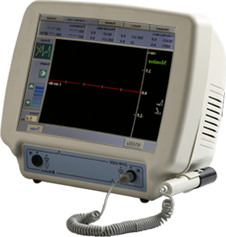
Blood flow assessment during surgery is critical to patient outcomes, and bidirectional Doppler is one of the most reliable tools for performing it intraoperatively. This guide from Kody Medical walks through how to position the probe, set the gain, read the waveform, and avoid the errors that most often lead to inaccurate readings.
What Is a Bidirectional Doppler?
A bidirectional Doppler (also written as a bi-directional Doppler) uses the Doppler shift principle to detect blood flow moving both toward and away from the probe, hence “bidirectional.” Using phase comparison, the device separates simultaneous forward and backward flow signals and routes them through two distinct channels. This allows artifact-free registration of arterial signals without venous superimposition and vice versa, giving a clean qualitative read on flow based on waveform shape, flow direction, and diastolic deflection.
Step-by-Step: How to Use a Bidirectional Doppler
Step 1: Select the right probe and frequency
Probe frequency determines depth penetration and resolution. Lower frequencies (5–8 MHz) reach deeper vessels but with less resolution; higher frequencies (10–20 MHz) give sharper resolution for superficial vessels but penetrate less. Match the probe to the vessel you’re assessing, for example, a higher-frequency intraoperative probe for superficial anastomoses versus a lower-frequency probe for deeper vascular structures.
Step 2: Prepare the site
Clean the area and apply an adequate, even layer of acoustic gel. Air gaps between the probe and tissue are one of the most common sources of signal loss, so make sure the gel fully bridges the contact surface before you start scanning.
Step 3: Position the probe at the correct angle
Hold the probe at roughly a 45–60° angle to the vessel rather than perpendicular to it. A perpendicular angle minimizes the Doppler shift and can produce a weak or absent signal even over a patent vessel. Move slowly and let the audio/waveform signal not just visual placement confirm you’re over the vessel.
Step 4: Set the gain
Start with the gain low and increase it gradually until you get a clean, audible signal without background noise or static. A gain set too high introduces an artifact that can be misread as flow; a gain set too low can cause you to miss a genuinely weak but present signal, particularly in low-flow or partially occluded vessels.
Step 5: Read the waveform
Once you have a stable signal, assess the following:
- Direction — flow toward the probe (typically displayed above the baseline) versus away from it (below the baseline)
- Waveform shape — triphasic (normal arterial), biphasic, or monophasic (suggesting upstream stenosis or occlusion)
- Diastolic deflection — its presence or absence helps distinguish normal versus compromised flow
Step 6: Record the parameters
Most bidirectional Dopplers display maximum velocity, average velocity, diastolic velocity, systolic-to-diastolic ratio (SD), resistance parameter (RP), pulsatility index (PI), and average/maximum volume (ml/min). Record these before and after the surgical step you’re assessing (e.g., before and after a clamp release or anastomosis) so you have a direct comparison.
Understanding Bidirectional Blood Flow
“Bidirectional blood flow” specifically refers to flow that reverses direction within the same vessel during the cardiac cycle, common in certain pathological states or near a partial obstruction, as opposed to flow that is simply moving in one direction but happens to be assessed by a bidirectional-capable device. A true bidirectional Doppler will display this reversal clearly as the waveform crossing the baseline, which a single-channel (unidirectional) Doppler cannot reliably distinguish from noise.
5 Common Errors When Using a Bidirectional Doppler
- Wrong probe angle. Scanning perpendicular to the vessel instead of at 45–60° is the single most common cause of a weak or false-negative signal.
- Insufficient or uneven gel coverage. Air pockets between the probe and skin attenuate the signal before it ever reaches the vessel.
- Gain set incorrectly. Too high introduces artifacts that mimic flow; too low causes genuine but weak signals to be missed.
- Misreading venous signal as arterial (or vice versa). Without checking waveform shape and pulsatility, a venous signal can be mistaken for a dampened arterial one, especially post-clamp.
- Not recording a baseline. Skipping a pre-intervention reading removes your only reference point for judging whether a post-intervention change is clinically meaningful.
Choosing the Right Bidirectional Doppler for Your Procedure
Kody Medical Electronics supplies a range of bidirectional Doppler devices and intraoperative probes built for different specialties and frequencies. Different procedures call for different devices and probe configurations. As a general reference:
- Bidop ES100V3, Smartdop 45, Smartdop 30EX — general intraoperative use across multiple specialties
- Hadeco Smartdop XT (6-port and 14-port) — multi-probe setups for departments running varied procedures
- DVM 4500—used across neurosurgery, cardiovascular surgery, oral surgery, urology and nephrology, plastic surgery, orthopaedic surgery, and digestive tract surgery, including aneurysm clipping, bypass surgery, varicocele and AV shunt procedures, transplant surgery, and PAD/spinal stenosis assessment
- Bidop7 and Smartdop 45—add a color display, a larger speaker, and an inbuilt battery for procedures where audible/visual confirmation across the room matters
Looking for the right bidirectional Doppler for your OR? Kody Medical Electronics supplies and services the full range above. Browse the vascular Doppler range or get in touch for help matching a probe to your procedure.
FAQ
How do you use a bidirectional Doppler? Select a probe matched to vessel depth, apply gel, hold the probe at a 45–60° angle to the vessel, adjust gain until the signal is clean, then read waveform direction, shape, and diastolic deflection before recording velocity and flow parameters.
What is bidirectional blood flow? It’s flow that reverses direction within the same vessel during part of the cardiac cycle, distinct from simply measuring flow with a bidirectional-capable probe. It shows up as the waveform crossing the baseline on a true bidirectional Doppler.
Is it “bidirectional Doppler” or “bi-directional Doppler”? Both spellings refer to the same device and principle; “bidirectional” is the more common form in clinical literature, but “bi-directional” is widely used interchangeably.
What’s the most common mistake when using a bidirectional Doppler? Holding the probe perpendicular to the vessel instead of at an angle is the most frequent cause of a weak or absent signal even when the vessel is patent.
Which bidirectional Doppler is used for cardiac or neurosurgery? The DVM 4500 is commonly used across neurosurgery, cardiovascular surgery, and several other specialties; the right choice ultimately depends on probe frequency needs and port configuration for your specific procedure.